
Omaha Hold'em
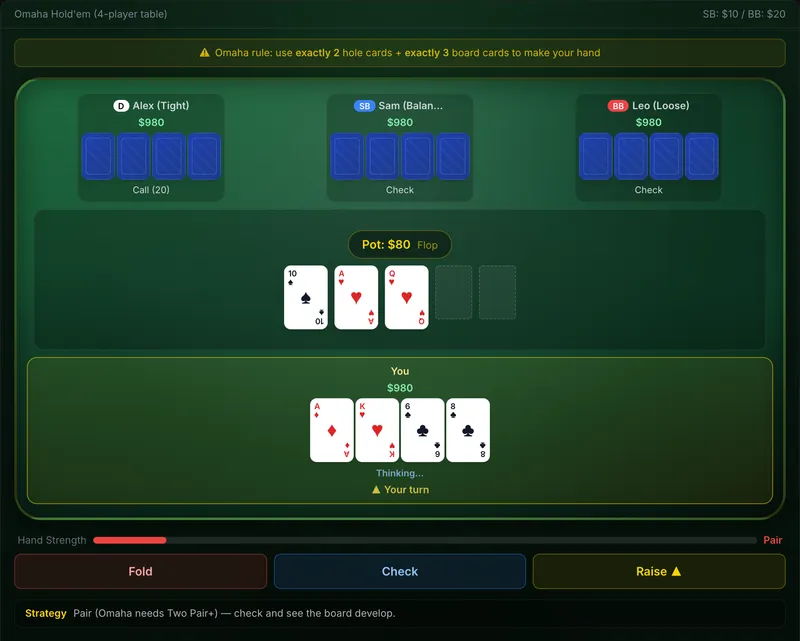
Omaha Hold'em is the second most popular poker variant worldwide — standard in European casinos and a fixture of high-stakes online poker. It closely resembles Texas Hold'em in structure (pre-flop, flop, turn, river betting rounds) but adds a defining twist: each player receives four hole cards instead of two, and must use exactly two of them — no more, no fewer — combined with exactly three of the five community cards to form a five-card hand. This seemingly small rule change radically reshapes the game: hands run closer together in strength, big draws are more likely to complete, and the 'nuts' (the best possible hand) is far more common. Two Pair and Three of a Kind are rarely winning hands at showdown. The result is an action-heavy game where skilled players must constantly evaluate not just their own hand but whether they hold the nut draw.
Play Omaha Hold'em Free
No signup · FreeRules & Gameplay
Each player is dealt four hole cards face down. Five community cards are dealt face up in three stages: Flop (3 cards), Turn (1 card), River (1 card). The Omaha rule: a player must use exactly 2 of their 4 hole cards and exactly 3 of the 5 community cards — no other combination is valid. If the board shows four spades and you hold one spade, you do not have a flush. Betting structure: typically Pot-Limit Omaha (PLO), where the maximum bet is the current size of the pot. Pre-flop: action starts left of the Big Blind (Under the Gun). Post-flop: action starts left of the dealer. Blinds and betting mechanics are identical to Texas Hold'em. At showdown, the player whose exactly-2-from-hand plus exactly-3-from-board combination ranks highest wins. Split pots occur when two players make identical five-card hands.
Basic Strategy
Hand selection in Omaha is fundamentally different from Texas Hold'em. Double-suited hands (two suits each appearing twice in your four hole cards) are far more valuable because they give you two separate flush draws. Connected rundown hands (like 5-6-7-8 suited) are premium — they can make straights and flushes in multiple ways. High pairs (AA, KK) retain value but are far less dominant than in Texas Hold'em, because flopping top set still leaves you vulnerable to straights and flushes. Always ask: 'Am I drawing to the nuts?' Omaha rewards players who draw to the best possible hand, not second-best draws. A nut flush draw is worth fighting for; a non-nut flush draw can be a trap. Pot-Limit structure means pot odds calculations are crucial — with pot-sized bets, you need 33% equity to call, which drawing to the nut flush with 9 outs easily achieves. Never overvalue hands that look strong in Texas Hold'em but are mediocre in Omaha.
At a Glance
- Category
- Card Games
- Sections
- Rules + Strategy
More Card Games
Card Games
Baccarat
Baccarat is the highest-stakes card game in the world, accounting for over 80% of casino r…
Card Games
Blackjack
Blackjack — also called Twenty-One — is the most widely played casino banking game in the …
Card Games
Texas Hold'em Poker
Texas Hold'em is the world's most popular form of poker, the game played in the World Seri…