
Baccarat
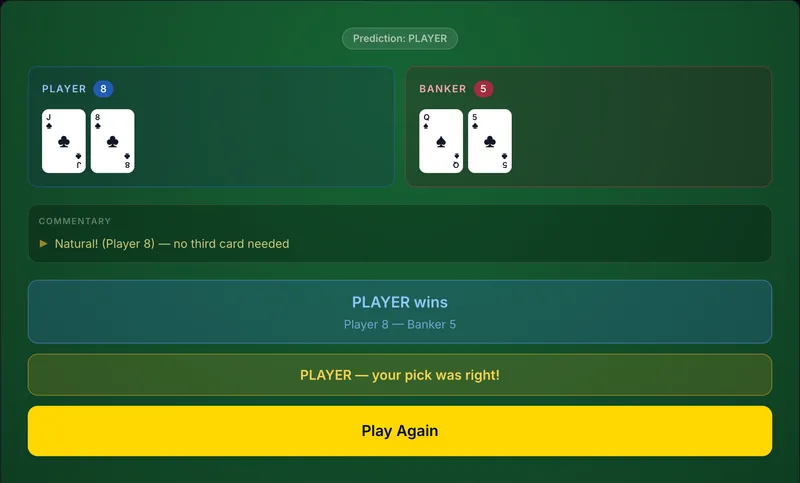
Baccarat is the highest-stakes card game in the world, accounting for over 80% of casino revenue in Macau and a dominant share in Singapore and Las Vegas. The game is deceptively simple: players bet on whether the Player hand or the Banker hand will come closest to a total of nine. Its association with James Bond, Macau's VIP rooms, and rolling chip programmes has made baccarat synonymous with luxury gambling culture globally. The house edge on the Banker bet — just 1.06% after the 5% commission — makes baccarat one of the most player-favourable games on the casino floor.
Play Baccarat Free
No signup · FreeRules & Gameplay
Two hands are dealt — Player and Banker — each receiving two cards face up. Card values: Ace = 1, cards 2–9 = face value, tens and face cards = 0. If either hand totals 8 or 9 on the first two cards, it is a 'natural' and no further cards are drawn. If the Player hand totals 0–5, the Player draws a third card. The Banker's draw rules depend on the Banker's total and, if applicable, the value of the Player's third card (complex tableau). The hand closest to 9 wins. Three bets are available: Player (pays 1:1, house edge 1.24%), Banker (pays 1:1 minus 5% commission, house edge 1.06%), and Tie (pays 8:1 or 9:1, house edge 14.36%). The Tie bet should always be avoided.
Basic Strategy
Always bet Banker. The Banker bet wins slightly more than 50% of all non-tie hands due to the drawing rules, making it the best recurring bet in the casino by expected value. Ignore any pattern-tracking scorecards — each hand is independent and previous results have no predictive value. Set a fixed session bankroll and stick to flat betting rather than chasing losses. Avoid the Tie bet entirely, regardless of apparent streaks. In commission-free baccarat variants, the Banker bet is even more favourable as the 5% vig is eliminated. For high-rollers playing punto banco in VIP rooms, negotiate a loss rebate before play begins.
At a Glance
- Category
- Card Games
- Sections
- Rules + Strategy
More Card Games
Card Games
Blackjack
Blackjack — also called Twenty-One — is the most widely played casino banking game in the …
Card Games
Texas Hold'em Poker
Texas Hold'em is the world's most popular form of poker, the game played in the World Seri…
Card Games
Omaha Hold'em
Omaha Hold'em is the second most popular poker variant worldwide — standard in European ca…