
European Roulette
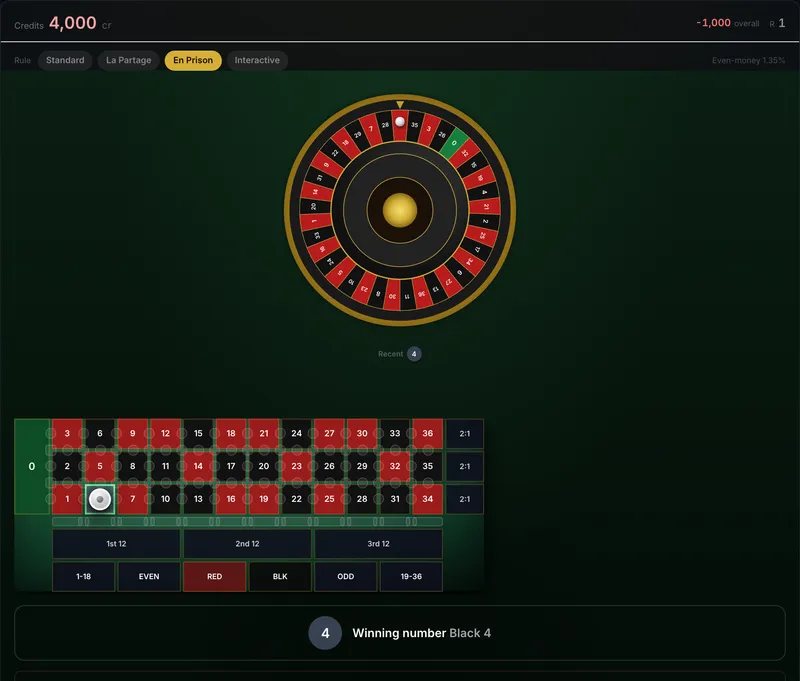
European Roulette is the standard form of roulette played in Macau, Europe, and most premium casino properties worldwide. The wheel contains 37 pockets numbered 0 through 36 in a non-sequential arrangement, with a single green zero. The single-zero wheel gives a house edge of just 2.70% on all even-money bets, compared to 5.26% on its American double-zero counterpart. In many European casinos, the La Partage rule further reduces the house edge to 1.35% on even-money bets when the ball lands on zero — making European Roulette one of the most player-favourable table games available.
Play European Roulette Free
No signup · FreeRules & Gameplay
Players place chips on the betting layout before the croupier spins the wheel and releases the ball. Betting options: Straight Up (single number, pays 35:1), Split (two adjacent numbers, pays 17:1), Street (three numbers in a row, pays 11:1), Corner (four numbers, pays 8:1), Line (six numbers, pays 5:1), Dozen (12 numbers, pays 2:1), Column (12 numbers, pays 2:1), Red/Black (pays 1:1), Odd/Even (pays 1:1), High/Low (1–18 or 19–36, pays 1:1). The single zero (0) is a loss for all outside bets unless La Partage or En Prison rules apply. La Partage: when zero hits, half of all even-money bets are returned. En Prison: even-money bets are 'imprisoned' for the next spin rather than lost.
Basic Strategy
European Roulette is a negative-expectation game — no betting system can overcome the house edge. However, choosing bets wisely manages your bankroll more effectively. Even-money outside bets (Red/Black, Odd/Even, High/Low) offer the best odds and longest playing time per unit staked. If La Partage or En Prison is available, exclusively play even-money bets to reduce the house edge to 1.35%. Avoid American Roulette wheels; the double zero nearly doubles the house edge. Column and dozen bets at 2:1 offer medium variance. Straight-up bets on single numbers pay 35:1 but carry the full 2.70% house edge and high variance. Never chase losses — each spin is independent.
At a Glance
- Category
- Table Games
- Sections
- Rules + Strategy
The Wheel Sequence
The 37 pockets read clockwise from the green zero in this fixed, non-sequential order:
Bets, Payouts & Odds
| Bet Type | Payout | Win Probability |
|---|---|---|
| Straight Up (1 number) | 35:1 | 2.70% |
| Split (2 numbers) | 17:1 | 5.41% |
| Street (3 numbers) | 11:1 | 8.11% |
| Corner (4 numbers) | 8:1 | 10.81% |
| Six Line (6 numbers) | 5:1 | 16.22% |
| Column (12 numbers) | 2:1 | 32.43% |
| Dozen (12 numbers) | 2:1 | 32.43% |
| Red / Black (18 numbers) | 1:1 | 48.65% |
| Odd / Even (18 numbers) | 1:1 | 48.65% |
| High / Low (18 numbers) | 1:1 | 48.65% |
European vs American vs French
| Variant | House Edge | Notes |
|---|---|---|
| European | 2.70% | 37 pockets with a single green zero. The standard wheel in Macau and most of Europe. |
| American | 5.26% | Adds a second 00 pocket (38 total), which nearly doubles the house edge. Avoid where possible. |
| French | 1.35% | Same single-zero wheel, but La Partage and En Prison apply to even-money bets by default. |
The European Roulette Wheel
The European wheel holds 37 numbered pockets — 0 through 36 — arranged in a deliberately non-sequential order so that high and low, red and black, and odd and even numbers are distributed as evenly as possible around the rim. Reading clockwise from the green zero, the sequence runs 0, 32, 15, 19, 4, 21, 2, 25 and so on. This scrambled layout is what makes the wheel statistically fair: no quadrant favours a particular colour or range.
Because of this fixed order, croupiers and advantage players describe the wheel in physical sectors rather than by number value. The three classic French sectors are Voisins du Zéro (the seventeen numbers around zero), Tiers du Cylindre (the twelve numbers opposite zero) and Orphelins (the eight remaining 'orphan' numbers). These sectors are the basis of the announced 'call bets' offered on a French-style racetrack.
House Edge and the Single Zero
Every payout on a European wheel is calculated as if there were 36 numbers, but there are actually 37 pockets. That single extra pocket — the green zero — is the entire house edge. A straight-up bet pays 35:1, yet the true odds of hitting one number are 36:1, and that gap produces a house edge of exactly 2.70% on every standard bet.
In practical terms, for every $100 you wager over the long run you can expect to lose about $2.70. That is less than half the 5.26% edge of American roulette, which is why experienced players seek out single-zero tables. No bet on the layout — inside or outside — carries a different edge; the 2.70% is uniform across the board.
La Partage and En Prison
Two rules can cut the house edge dramatically, and both apply only to the even-money outside bets: Red/Black, Odd/Even and High/Low. Under La Partage ('the sharing'), when the ball lands on zero you immediately receive half of your even-money stake back instead of losing it all. Under En Prison ('in prison'), your even-money bet is instead locked for one more spin; if it wins on that next spin you recover the full stake.
Either rule halves the effective house edge on even-money bets from 2.70% down to just 1.35% — turning European roulette into one of the most player-favourable games on the casino floor. Always check whether a table offers La Partage or En Prison before you sit down; if it does, even-money bets become the mathematically smartest play.
Inside Bets vs Outside Bets
Inside bets are placed on individual numbers or small groups within the number grid — straight up, split, street, corner and six line. They pay more (up to 35:1) but hit far less often, producing high variance and short bursts of big wins or long dry spells. Outside bets sit around the edge of the layout — dozens, columns and the even-money propositions — and cover twelve to eighteen numbers at once for smaller, more frequent payouts.
A common approach is to anchor a session with even-money outside bets for staying power, then sprinkle occasional inside bets when you want a shot at a larger payout. Neither approach changes the underlying edge, but outside bets stretch your bankroll across many more spins.
Why Betting Systems Cannot Beat the Wheel
Every spin of a fair European wheel is independent: the ball has no memory of previous results, so a run of ten reds does nothing to make black more likely on the next spin. Progression systems such as the Martingale (doubling after each loss), the Fibonacci or the D'Alembert can feel like they work because they win small amounts often — but they only postpone losses. A long losing streak eventually meets the table maximum or exhausts your bankroll, and a single such streak wipes out all the small wins that came before.
The only genuine edge reduction available to an honest player is structural: choosing a single-zero wheel and playing even-money bets where La Partage or En Prison applies. Treat roulette as entertainment with a known cost, set a loss limit before you start, and never chase losses.
Frequently Asked Questions
What is the house edge in European Roulette?
European Roulette has a house edge of 2.70% on every bet, thanks to its single green zero. On even-money bets (Red/Black, Odd/Even, High/Low) that edge drops to just 1.35% at tables that offer the La Partage or En Prison rule.
Is European Roulette better than American Roulette?
Yes. European Roulette has one zero and a 2.70% house edge, while American Roulette adds a second 00 pocket that raises the edge to 5.26% — nearly double. If you have the choice, always play the single-zero European wheel.
What is the La Partage rule?
La Partage means that when the ball lands on zero, you get half of your even-money bet returned instead of losing it all. It halves the effective house edge on those bets from 2.70% to 1.35%.
What are the odds of hitting a single number?
There are 37 pockets on a European wheel, so the chance of a straight-up bet winning is 1 in 37, or about 2.70%. It pays 35:1, while the true odds are 36:1 — that difference is the house edge.
What is the difference between European and French Roulette?
They use the same single-zero wheel. French Roulette applies the La Partage and En Prison rules to even-money bets by default and offers announced 'call bets' on the racetrack, giving it a 1.35% edge on those bets.
Can you win consistently at European Roulette?
No betting system can overcome the built-in house edge, because every spin is independent. You can reduce the edge by playing a single-zero wheel and even-money bets with La Partage, but roulette remains a negative-expectation game best treated as entertainment.
What is the best bet in European Roulette?
The best value comes from even-money outside bets — Red/Black, Odd/Even or High/Low — at a table that offers La Partage or En Prison, where the house edge is only 1.35% and your bankroll lasts the longest.
Is this European Roulette game free to play?
Yes. The European Roulette game on this page runs free in your browser with no signup and no download. It is a practice simulator that uses play chips, so you can learn the bets and the wheel with no real-money risk.
Explore Roulette Variants
The house edge changes dramatically between roulette variants. Compare and play each one:
More Table Games
Table Games
American Roulette
American Roulette is the standard form of roulette in Las Vegas and most North American ca…
Table Games
French Roulette
French Roulette is the original form of roulette as developed in 18th-century France and t…
Table Games
Big Six Wheel
The Big Six Wheel — also known as the Wheel of Fortune, Money Wheel, or simply the Big Whe…